My latest research focuses on leveraging multiple speakers to enhance crosstalk reduction. As a reminder, this is an audio signal processing technique that effectively delivers independent sounds to each ear, creating a convincing spatial experience. This method of achieving binaural listening via loudspeakers is known as transaural audio, and you can see a breakdown of the fundamentals in my video
The primary engineering challenge lies in maintaining robustness—ensuring the 3D effect doesn't collapse if the listener moves slightly—while preventing tonal deformation that can unnaturally color the audio.
While traditional transaural setups rely on just two speakers, we can achieve significantly better results by expanding the array. By adding a center speaker or moving to 4 or even 5-speaker configurations, we gain more control over the sound field.
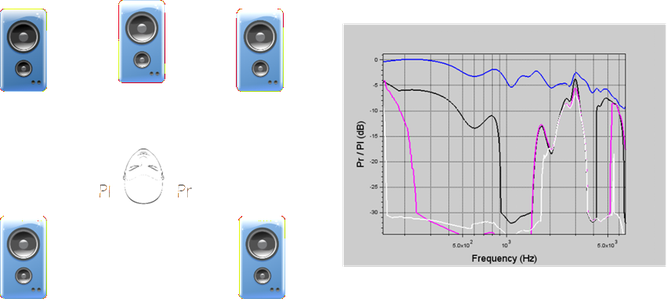
This improvement is clearly illustrated in the graphs below. First, let’s consider a single loudspeaker positioned at 20° to the left of the listening position. The ratio between the sound pressure at the right and left ears (the crosstalk) is visualized as follows
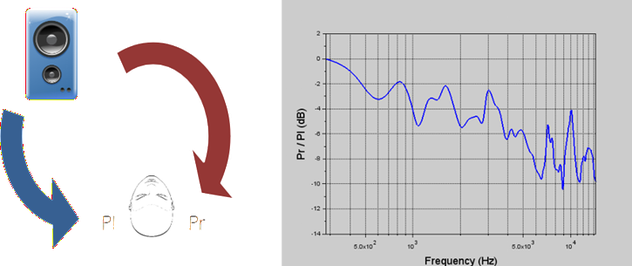
At low frequencies, the ratio is approximately 1, but it decreases as the frequency rises because the head provides acoustic shadowing for shorter wavelengths. Our objective is to use additional speakers to minimize this ratio as much as possible while preserving the same tonal balance as if the 'main' speaker was playing alone.
Here is what can be achieved by using a second speaker in a symmetrical, standard stereo configuration. The blue curve remains our reference (no crosstalk reduction), while the black curve shows the improvement gained by adding that second speaker
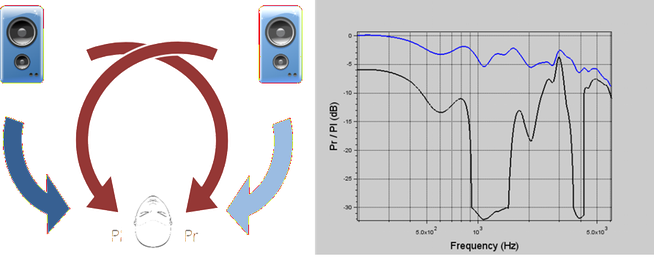
Incorporating a third loudspeaker in the center yields even better results, particularly in the mid-range. This is a critical area where the comb filtering inherent in standard stereo configurations can be highly detrimental to the natural timbre of voices.
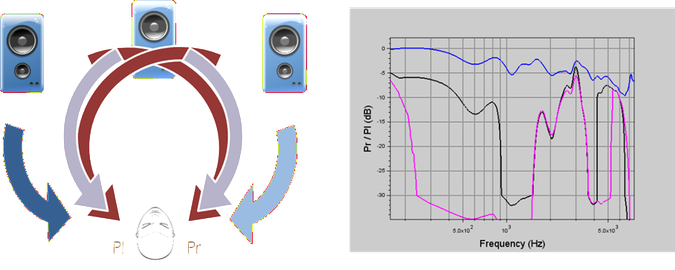
The high-frequency (treble) range can be further refined by moving to a 5-speaker array, with the two additional units positioned at +/- 10°. This tighter configuration provides the precision necessary to manage shorter wavelengths
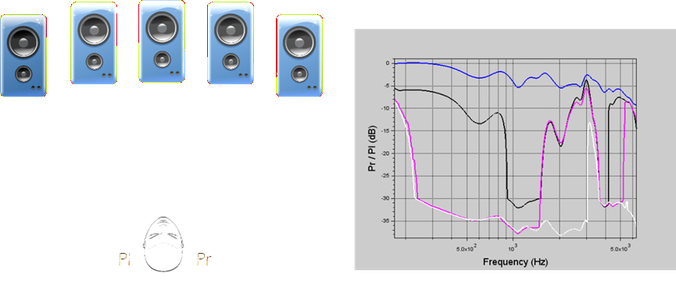
A different—and highly effective—compromise can be reached if you already have a standard 5.1 layout. By adapting the algorithm to this existing hardware, we can repurpose the surround and center channels to maximize crosstalk cancellation without requiring a custom speaker array
By moving beyond simple stereo, we can finally overcome the physical limitations of traditional listening spaces and unlock truly immersive soundscapes. I invite you to contact me directly to learn more about testing these filters for your specific application